
- trackaffadmin
- 0 Comments
- 24 Views
The most reliable way to track a Facebook ad funnel is to separate campaigns by stage (TOFU, MOFU, BOFU), run Pixel and Conversions API together with a stable event_id for deduplication, and report on blended ROAS across the whole funnel instead of judging each stage in isolation. That setup fixes the two biggest failure points in Meta tracking: lost signal and misread data. The implementation checklist below walks through each piece in order.
TL;DR:
- Separating campaigns by funnel stage and reporting blended ROAS prevents misreading Meta’s last-touch attribution bias.
- Tracking the full purchase journey requires using standard events with event_id, verifying deduplication, and combining Pixel with Conversions API.
- Reconcile Meta data with Google Analytics and backend orders weekly to detect significant attribution discrepancies and extend attribution windows for longer buying cycles.
- Diagnosing funnel leaks involves ranking drop-off rates at each step, matching likely causes, and running targeted A/B tests before making changes.
- Building a large, warm retargeting audience takes four to six weeks of consistent top-funnel advertising before evaluating BOFU performance.
Table of Contents
- What Is Funnel Tracking on Facebook and Why Does It Break?
- How TOFU, MOFU, and BOFU Map to Meta Campaign Objectives
- Which Events Should You Track at Each Funnel Step?
- How Do You Set Up Pixel and CAPI Together Without Double Counting?
- How Do You Reconcile Meta, GA4, and Backend Data?
- How Do You Diagnose Where Your Funnel Is Leaking?
- What Should You Check This Week to Validate Your Tracking?
- What Marketers Get Wrong About Funnel Tracking
- A Practical Option for Guaranteed Post-Click Reporting
- Where to Go Next for Setup Details
- Sources
- FAQ
What Is Funnel Tracking on Facebook and Why Does It Break?
Funnel tracking on Facebook (Meta) means measuring how a prospect moves from ad impression to purchase across distinct campaign stages, using events, attribution windows, and reconciliation against other data sources. It breaks most often for one reason: marketers treat Meta’s reported numbers as absolute truth for every campaign, when Meta’s own attribution model is built to reward the last touch, not the full journey.
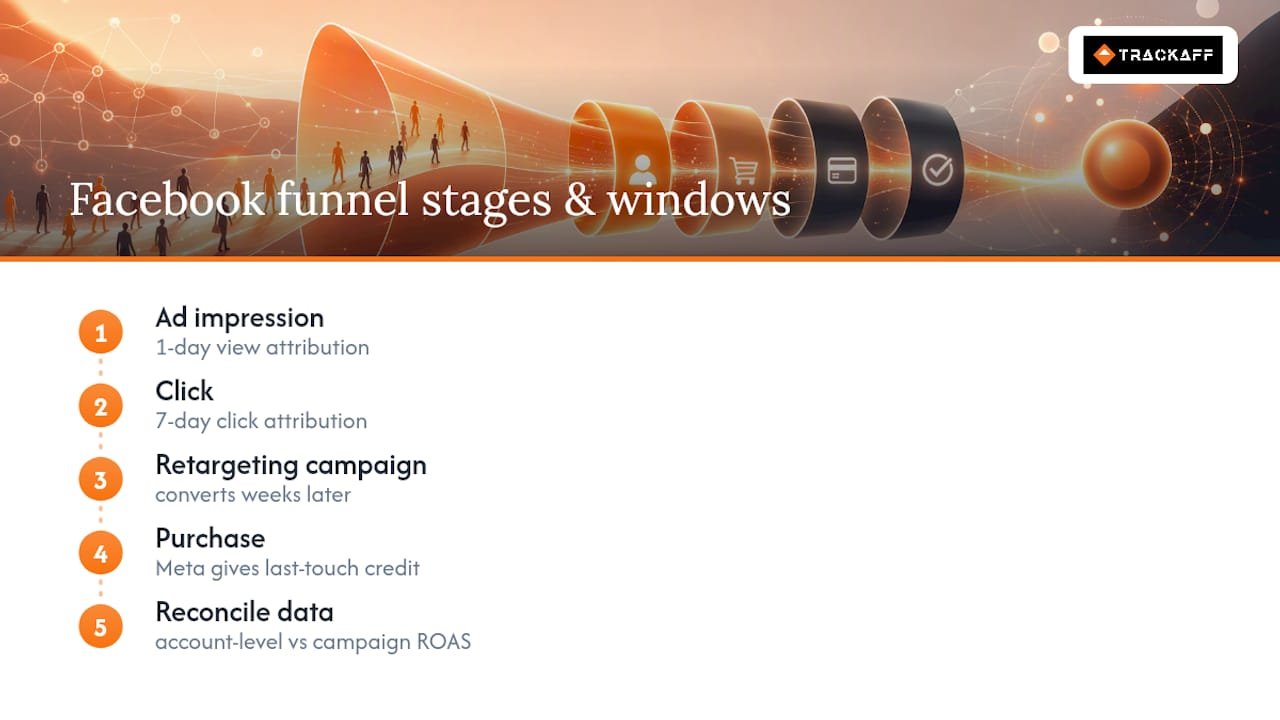
Meta’s default attribution window is 7-day click and 1-day view, a setting built for last-click credit. That default makes top-of-funnel campaigns look weak even when they are doing exactly their job: introducing cold audiences who convert weeks later through a retargeting campaign. Facebook funnel analytics only works when you stop reading each campaign’s ROAS alone and start reading the account-level picture.
How TOFU, MOFU, and BOFU Map to Meta Campaign Objectives
Each funnel stage does a different job, and grading all three by the same metric is the fastest way to kill a campaign that’s actually working.
- TOFU (top of funnel): Awareness or Engagement objectives, cold audiences. Judge it on CPM, video-view rate, and how fast your warm audience pool grows, not on immediate purchases.
- MOFU (middle of funnel): Traffic or Leads objectives, aimed at people who engaged but haven’t bought. Judge it on click-through rate, landing page views, and cost per lead.
- BOFU (bottom of funnel): Leads or Sales objectives, aimed at cart abandoners and warm retargeting pools. Judge it on ROAS, cost per purchase, and frequency (watch for ad fatigue as frequency climbs past 3 to 4).
Run TOFU, MOFU, and BOFU as separate campaigns rather than ad sets inside one campaign. Meta’s auction competes against itself when stages overlap, and excluding lower-funnel audiences from top-funnel campaigns stops that cannibalization before it inflates your cost per result.
Which Events Should You Track at Each Funnel Step?
Facebook funnel tracking lives or dies on event quality. Track the four standard purchase-path events (ViewContent, AddToCart, InitiateCheckout, Purchase) plus Lead if your funnel captures sign-ups before a sale. Every event needs value, currency, content_ids, and an event_id whenever the platform supports it.
Micro-events matter almost as much. Form start, form submit, and button click events won’t show up in Meta’s core reporting, but they’re what tell you whether a drop-off happened on your landing page or inside your checkout. A funnel step with strong AddToCart volume and weak Purchase volume is a checkout problem, not an ad problem, and no amount of creative testing fixes it. Mapping the sequence from AddToCart through InitiateCheckout to Purchase is the fastest way to isolate that friction.
| Event | Funnel Step | Primary KPI |
|---|---|---|
| ViewContent | TOFU/MOFU | Landing page view rate |
| AddToCart | MOFU | Add-to-cart rate |
| InitiateCheckout | MOFU/BOFU | Checkout initiation rate |
| Purchase | BOFU | Cost per purchase, ROAS |
| Lead | MOFU | Cost per lead |
Pro Tip: If AddToCart looks healthy but Purchase lags, check your checkout page load time and payment options before touching your ad creative. Slow checkouts and missing payment methods kill more sales than bad targeting ever does.
How Do You Set Up Pixel and CAPI Together Without Double Counting?
Pixel alone misses a growing share of events because of browser restrictions, ad blockers, and iOS privacy settings. Conversions API sends the same events server-side, filling gaps the browser can’t cover. Neither one alone gives you the full picture, and running them without deduplication rules inflates your reported conversions, sometimes badly enough to distort your entire ROAS calculation.
Here’s the setup sequence that keeps both signals clean:
- Generate one event_id client-side for each conversion event, tied to that specific transaction.
- Reuse the exact same event_id server-side when CAPI fires the matching event, so Meta’s deduplication system recognizes them as one event, not two.
- Send hashed match parameters (email, phone, external_id) with both Pixel and CAPI events to raise match quality and attribution accuracy.
- Verify your domain in Events Manager and configure Aggregated Event Measurement (AEM) event prioritization so your highest-value events (typically Purchase) get reported first under iOS limits.
- Place a test order and check Events Manager for the deduplication status on that event, confirming it shows as one event, not a duplicate pair.
Combining Pixel with CAPI is the standard fix for signal loss, but deduplication errors are the most common technical cause of inflated conversion counts once both are live. Check Events Manager weekly, not just at setup, since match rate can drift as browser policies change.
How Do You Reconcile Meta, GA4, and Backend Data?
Blended ROAS means total revenue across your entire funnel divided by total ad spend across your entire funnel, calculated at the account level rather than per campaign. It exists specifically to counter the last-click bias baked into Meta’s default attribution window, which otherwise makes a TOFU campaign that seeded ten purchases three weeks later look like a total loss.
- Pull Meta spend and conversions, GA4 sessions and revenue, and backend order totals daily.
- Reconcile all three sources weekly and flag any delta larger than 10 to 15%.
- Extend your attribution window beyond Meta’s 7-day click default if your buying cycle runs longer, especially for considered purchases like insurance or financing.
- Set an acceptance threshold before scaling budget. Don’t increase spend on a campaign until its numbers hold steady across two reconciliation cycles.
Comparing Meta’s numbers against Google Analytics and backend orders will always show some variance, because each system uses a different attribution model and identity resolution method. The goal isn’t a perfect match. It’s catching the moment the gap widens enough to signal a tracking break.
Pro Tip: Building a genuinely warm retargeting audience through consistent TOFU spend typically takes four to six weeks. Don’t judge BOFU performance against a pool that hasn’t had time to fill.
How Do You Diagnose Where Your Funnel Is Leaking?
A funnel leak shows up as a gap between one step’s volume and the next: impressions to clicks, clicks to landing page views, landing page views to InitiateCheckout, InitiateCheckout to Purchase. Whichever gap is largest as a percentage is where you fix first, not wherever feels most urgent.
- Calculate the drop-off rate at each step and rank them by size, not by dollar amount lost.
- Match the leak to its likely cause. A weak click-through rate points to creative fatigue. A weak landing-page-to-checkout rate points to page speed or unclear offers. A weak checkout-to-purchase rate points to payment friction, unexpected shipping costs, or a broken form.
- Check for audience overlap between campaigns using Meta’s audience overlap tool, and add exclusions if the same users are showing up in both your TOFU and BOFU pools.
- Run an A/B test on exactly one variable tied to the suspected cause before touching anything else, so you know what actually moved the number.
A funnel leak calculator built specifically to flag the biggest drop-off point can save you the manual math and point straight at the highest-leverage fix.
What Should You Check This Week to Validate Your Tracking?
Run through this sequence before you trust any number your dashboard shows you.
- Install Pixel on every funnel page, then implement CAPI as the server-side backup.
- Generate a stable event_id and confirm it passes identically through both Pixel and CAPI.
- Place one test order and verify deduplication status in Events Manager.
- Standardize UTM parameters across every campaign using a fixed template, such as utm_source=meta and utm_medium=paid_social, so GA4 captures campaign data consistently.
- Set report templates for daily, weekly, and monthly review.
| Check | Frequency | Acceptance Threshold |
|---|---|---|
| Dedup status | Weekly | No duplicate events flagged |
| Match rate | Weekly | Stable or improving |
| Event values | Daily | Consistent with backend orders |
| Blended ROAS | Monthly | Reconciled against GA4 and backend |
What Marketers Get Wrong About Funnel Tracking
Most tracking failures aren’t technical. They’re a marketer cutting a TOFU campaign because its standalone ROAS looks bad, without checking whether it fed the warm audience that made BOFU profitable. That single habit does more damage to a Meta account than any missing pixel event.
Three shortcuts consistently save the most time: place one test order before trusting any new setup, prioritize getting Purchase event deduplication right before worrying about smaller events, and standardize UTM naming across every campaign on day one instead of retrofitting it later. Skip these and you’ll spend weeks chasing numbers that were never accurate to begin with.
— Terry
A Practical Option for Guaranteed Post-Click Reporting
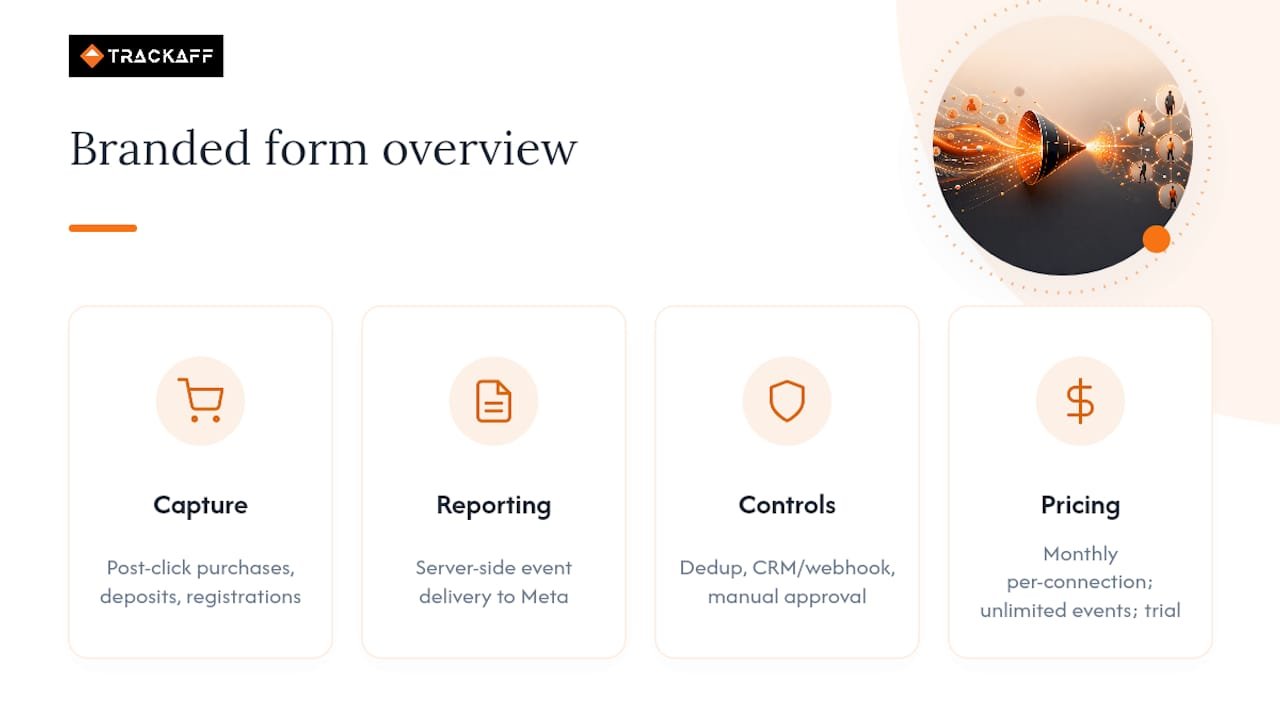
A solution closes the gap that Pixel and CAPI can’t close on their own: what happens after the click, off your site, where Meta has no visibility. A branded form embedded in your funnel captures the actual purchase, deposit, or registration and reports it back to Meta server-side, so the platform optimizes toward buyers instead of clicks or sign-ups.
That matters because Meta can only optimize for what it can see. If your funnel only reports leads, Meta keeps finding you more leads, not more customers. This setup can include deduplication support, CRM and webhook integration, and manual approval mode, so you control exactly which events count as real conversions before they ever reach the platform.
Plans run per month, per connection depending on scale, with unlimited event submissions on every tier and a free trial available. Check the pricing plans to find the connection tier that fits your funnel volume, or visit the product overview to see how the branded form fits into your existing setup.
Where to Go Next for Setup Details
For the technical side, Meta’s own Events Manager documentation covers Pixel, CAPI, and Aggregated Event Measurement configuration in more depth than any third-party guide. For funnel sequencing and attribution logic, the TOFU/MOFU/BOFU breakdown and the funnel leak calculator are worth bookmarking. For product specifics on post-click attribution, Trackaff’s pricing page lists current plan details.
Sources
- Adplay
- Meta Ads Tracking and Attribution: How to Set It Up Right
- Sales funnel tracking | Wingify
- Facebook Ads Funnel Leak Calculator – Find Where You’re Losing Money | HumanCalculations
- How to analyze your Facebook ad funnel using Facebook and Google Analytics | Social Media Examiner
FAQ
What Is Funnel Tracking on Facebook?
Funnel tracking on Facebook means measuring how prospects move from ad impression through purchase across distinct campaign stages, using Pixel, Conversions API, and event data. It requires separating TOFU, MOFU, and BOFU campaigns and reading results at the account level, not just per campaign.
Why Does Meta Underreport Top-of-Funnel Performance?
Meta’s default attribution window is 7-day click and 1-day view, which rewards the last touch before a purchase. A TOFU campaign that introduces a buyer who converts three weeks later through retargeting gets no credit in that campaign’s own reporting, even though it started the sale.
What’s the Difference Between Pixel and Conversions API?
Pixel tracks events client-side through the browser, while Conversions API sends the same events server-side, bypassing browser restrictions and ad blockers. Using both together with a shared event_id for deduplication gives Meta the most complete and accurate conversion data.
How Much Does Trackaff Cost?
Trackaff prices its plans per connected funnel, starting at $49 per month per connection on the Scale Rate plan, $69 on Growth Rate, and $99 on Starter Rate, each with unlimited event submissions. Enterprise pricing is available on request through the pricing page.
How Long Does It Take to Build a Warm Retargeting Audience?
Building a warm audience large enough to retarget effectively typically takes four to six weeks of consistent top-funnel spend. Judging BOFU performance before that window closes usually leads to premature budget cuts on campaigns that just need more time.
Recommended
Your deals close off the pixel. Meta never finds out.
TrackAff reports your real conversions back to Meta the moment they happen, tied to the exact ad that produced them. 10-minute setup, no code.
Start free 14-day trial → Card required · No charge until day 14 · Cancel in one click