

- trackaffadmin
- 0 Comments
- 32 Views
Value optimization, listed in Ads Manager as “Maximize value of conversions,” tells Meta’s algorithm to bid toward the highest total conversion value rather than the highest number of conversions. It works only when you’re sending clean, per-event purchase value through the Pixel or Conversions API and have enough conversion volume to train the algorithm. Get those two things right, and you typically see higher average order value and stronger ROAS, sometimes with fewer total conversions.
TL;DR:
- Value optimization requires accurate purchase value and sufficient weekly purchase volume, ideally around 50 per ad set, to perform effectively.
- Proper setup involves sending dynamic value data, aligning campaign objectives with sales, and ensuring high event match quality through Pixel and Conversions API deduplication.
- Flat or hardcoded value signals, low conversion volume, or off-site transactions not tracked by Pixel can cause poor performance or prevent enabling value optimization.
- Using server-side tracking solutions like Trackaff improves data accuracy when conversions occur outside the browser, boosting Meta’s ability to optimize effectively.
- Most issues stem from data quality problems rather than bid strategy choice, so fixing the conversion tracking infrastructure is more critical than selecting between highest value, ROAS goal, or cost cap.
Table of Contents
- What Is Value Optimization on Facebook?
- What Do You Need Before Enabling Value Optimization?
- How Does Value Optimization Actually Work Under the Hood?
- How Do You Set Up Value Optimization Step by Step?
- Highest Value, ROAS Goal, Cost Cap, or Lowest Cost: Which Should You Use?
- Why Isn’t Value Optimization Working, and How Do You Fix It?
- Why Server-Side Post-Click Tracking Changes the Value Optimization Equation
- The Bottom Line on Value Optimization
- What Most Advertisers Get Backwards About Value Optimization
- Get Accurate Post-Click Value Data With Trackaff
- Sources
What Is Value Optimization on Facebook?
Standard conversion campaigns optimize for the cheapest conversion, treating a $12 order the same as a $1,200 order. Value optimization changes the target: Meta bids to maximize the total dollar amount of conversions your budget produces, not the count.
The mechanism is simple once you see it. Every time your Pixel or Conversions API sends a purchase event, it carries a numeric value and a currency code. That number becomes training data. Meta’s official documentation on Maximizing the Value of Conversions confirms the option requires you to pass purchase value data. Without it, the algorithm has nothing to optimize toward, and the option won’t even appear as usable in your bid strategy settings.
You’ll see this framed a few different ways inside Ads Manager and in industry writing:
- Value as a performance goal, chosen when creating or editing a campaign
- Maximize value of conversions, the literal label Meta uses in its help documentation
- Value-based bidding (VBO), the shorthand most practitioners use in conversation
The practical difference from cost-based optimization is where the algorithm spends its curiosity. A “Lowest cost” campaign will happily fill your account with $9 buyers if they’re cheap to acquire. A value-optimized campaign starts favoring the $150 buyers, even if they cost more per click, because the training signal rewards revenue, not raw volume.
What Do You Need Before Enabling Value Optimization?
Eligibility isn’t a toggle Meta grants you. It’s a set of technical and data conditions you have to satisfy first, and skipping any one of them is the most common reason advertisers try value optimization once, see it underperform, and abandon it.
- Send value and currency with every Purchase event. The value field needs a real number tied to that specific transaction, not a static placeholder, and the currency code has to match your ad account’s reporting currency.
- Build sufficient conversion history. There’s no official hard minimum, but a widely used rule of thumb from Shopify’s guide to optimizing Facebook ads puts the stable threshold around 50 purchases per week per ad set. Below that, Meta’s algorithm is guessing more than learning.
- Run the right campaign objective. Value optimization is only selectable under the Sales objective with the Purchase event configured as the optimization event. It won’t surface under Leads or Engagement campaigns.
- Deduplicate Pixel and Conversions API events. If both fire for the same purchase without a shared
event_id, Meta may count it twice, corrupting the value signal it thinks it’s learning from. - Confirm Event Match Quality is healthy. Check the EMQ diagnostics inside Events Manager before you switch bid strategies. Weak matching means Meta can’t reliably tie the value you’re sending back to a real person on its platform.
Skip the volume check and you’ll get a bid strategy that looks live in the interface but starves for data in practice. Skip deduplication and you’ll get a value signal that’s technically present but quietly wrong.
How Does Value Optimization Actually Work Under the Hood?
Two things determine whether value optimization performs well: how confidently Meta can match your event to a real user, and what number you actually send as “value.” Get either one wrong and the algorithm optimizes toward garbage with total confidence.
Event Match Quality, or EMQ, is Meta’s internal score for how well a conversion event ties back to a specific person on the platform. Browser-only Pixel tracking loses signal constantly, ad blockers, Safari’s tracking restrictions, and iOS 14+ prompts all cut into it. Server-side Conversions API calls, sent directly from your backend with hashed email, phone, and external ID, tend to raise EMQ because they don’t depend on a browser cooperating.
The second variable is what number you’re actually sending. This is where most advertisers underthink the setup:
- Send raw revenue, and Meta chases the biggest first-order sale, even from a customer who churns immediately or returns half the order.
- Send contribution margin (revenue minus product cost, shipping, and payment fees), and Meta starts favoring customers who are actually profitable, not just expensive to acquire.
- Send predicted lifetime value (pLTV), and Meta can optimize toward customers likely to buy again, which is where subscription and repeat-purchase businesses see the biggest upside.
Servo’s analysis of value-based bidding makes the case plainly: Meta optimizes toward whatever value you send it, so sending profit instead of revenue steers the auction toward customers who are good for the business, not just good for the top line.
Statistic to watch: Adfirm’s practitioner reporting on Meta value optimization found accounts switching to VBO saw average ROAS gains around 12%, but the same reporting flagged that dirty or inflated value data can spike acquisition costs sharply instead of lowering them.
The guardrail here matters. A pLTV model built on thin data or a value field that’s been manually inflated to “help” performance will train Meta on noise. The algorithm doesn’t know the difference between a genuinely high-value customer and a data error. It just bids harder toward whatever number shows up most often.
How Do You Set Up Value Optimization Step by Step?
Treat this as a pre-flight checklist. Every step below either builds the data foundation or protects it once it’s live.
- Implement Pixel and Conversions API together, not one or the other. Pixel catches browser-side behavior; Conversions API sends server-confirmed events with hashed customer identifiers. Running both, with a shared
event_id, is what protects you from double counting while maximizing match rate. - Decide what “value” means for your business before you touch the campaign settings. Revenue is simplest but crudest. Contribution margin is better for most direct response advertisers. pLTV is worth the effort only if you have enough repeat-purchase history to model it credibly.
- Strengthen Event Match Quality by passing email, phone number, and external ID with every server-side event, all hashed per Meta’s requirements. Check the EMQ score in Events Manager after each change.
- Check that your value distribution isn’t flat. If every purchase event reports the exact same value, Meta has nothing to differentiate, and the algorithm can’t tell a good customer from an average one. Pull a spot check of raw event data before you launch.
- Confirm “Value” is selectable as your performance goal inside the ad set’s bid strategy section. If it’s grayed out, one of the prerequisites above hasn’t been met yet.
- Set a testing window of two to six weeks and decide in advance which three metrics you’re watching: ROAS, average order value, and total conversion volume. Write the baseline numbers down before you switch.
Pro Tip: Pull a sample of 20 to 30 recent Purchase events straight from Events Manager and eyeball the value field. If more than a couple share the identical number, you likely have a static value bug, not a real distribution, and value optimization will underperform until you fix it.
The sequencing matters more than advertisers assume. Shopify’s guide to Facebook ad optimization recommends handling creative and audience setup before touching bid strategy, on the logic that a bidding change layered on top of unstable creative performance just adds noise to noise. Fix the inputs first. Adjust the bid strategy last.
Highest Value, ROAS Goal, Cost Cap, or Lowest Cost: Which Should You Use?
Meta gives you four meaningfully different levers, and picking the wrong one for your stage of data maturity is a common way value optimization gets blamed for a targeting or budget problem.
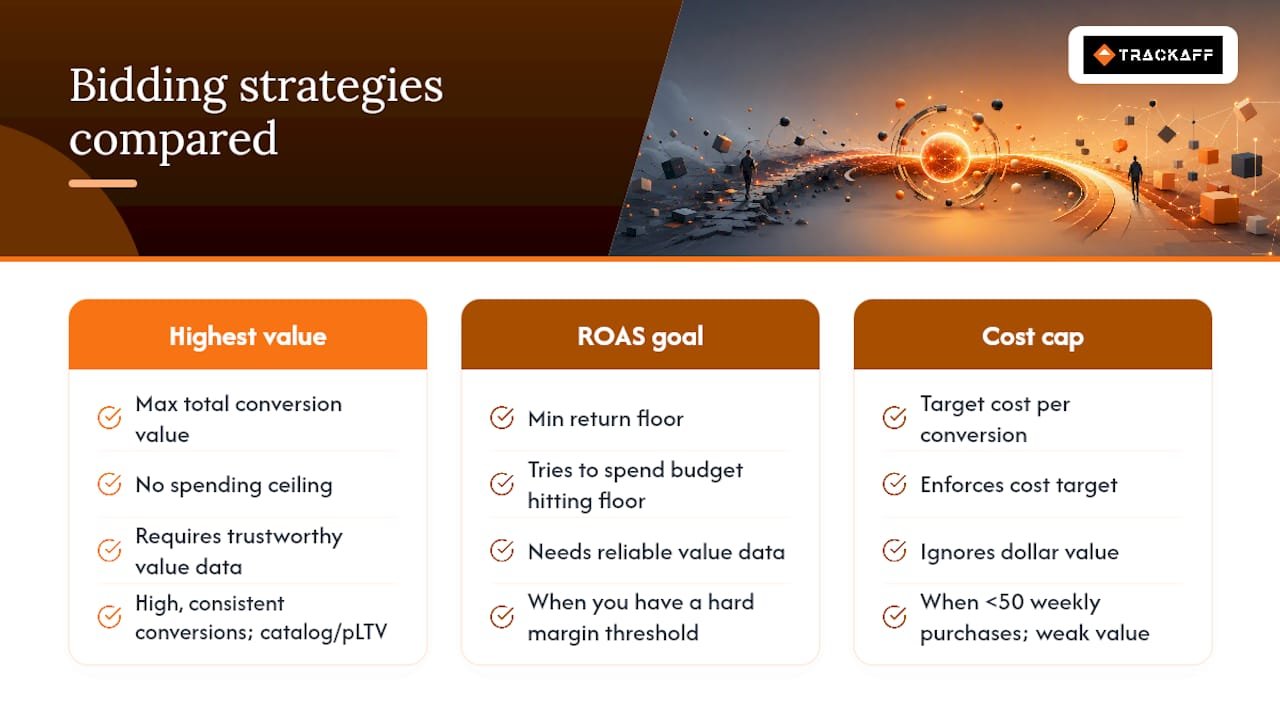
Highest value tells Meta to spend your full budget chasing the largest total conversion value without a ceiling. It fits accounts with strong, consistent conversion volume and confidence in their value data, typically catalog businesses with wide price variance or DTC brands using pLTV.
ROAS goal adds a floor. You tell Meta the minimum return you’ll accept, and it tries to hit that bar while still spending the budget. Meta’s own bidding guidance frames this as the more conservative sibling of Highest value, useful when you have a hard margin threshold you can’t afford to slip below.
Cost cap and Lowest cost stay outside true value optimization. They optimize for conversion count or a target cost per conversion, ignoring the dollar value entirely. They’re the right starting point when you don’t yet have 50+ weekly purchases per ad set or trustworthy value data.
Value rules sit alongside all of this as a coarser, manual layer. Rather than retraining the algorithm, they apply multipliers, boosting or discounting bids for specific segments like device type, placement, or a custom audience. They work best layered on top of already-broad targeting rather than as a substitute for it.
Statistic to watch: Meta’s own guidance on bidding strategies and value rules recommends starting with conservative rule adjustments, in the 10% to 20% range, rather than aggressive multipliers, paired with a testing window of two to six weeks before judging results.
Set your ROAS floor from actual contribution margin, not a round number that feels ambitious. If margin says you need a 2.5x return to stay profitable, that’s your floor, full stop.
Why Isn’t Value Optimization Working, and How Do You Fix It?
Three symptoms show up more than any others, and each has a specific diagnostic path.
The Value option is grayed out or missing entirely. This almost always traces back to insufficient purchase volume, a missing value parameter on the Purchase event, or the wrong campaign objective selected. Check Events Manager first, then confirm the objective is Sales with Purchase as the optimization event.
ROAS is declining while cost per result climbs. Walk through this in order: value parameter present and non-zero, EMQ score, Pixel/CAPI deduplication via event_id, then creative and landing page conversion rate. A weak landing page will tank ROAS regardless of how well your bidding is configured, and no amount of bid strategy tuning fixes a broken checkout flow.
Your value distribution is flat. If every event reports the same number, or close to it, the algorithm has no meaningful signal to chase. This usually means a hardcoded value in your tracking setup rather than a dynamic one pulled from the actual transaction.
Campaign fragmentation compounds all three problems. Splitting budget across too many ad sets starves each one of the conversion volume needed to train reliably, a discipline point industry ROI analysis of Facebook ads raises directly when discussing why testing often fails at low budgets. Consolidating ad sets to concentrate signal is frequently the fix, not a new bidding strategy.
Pro Tip: If you’re mid-crisis and can’t isolate the cause fast, revert to Lowest Cost temporarily. It buys you conversion volume while you fix the signal problem, rather than compounding a bad situation by leaving a broken value signal live under Highest Value bidding.
- Value option missing → check purchase volume, value parameter, campaign objective
- ROAS falling, cost rising → check EMQ, deduplication, then creative and landing page
- Flat value distribution → check for hardcoded values in your tracking implementation
- Everything technically correct but still underperforming → check for campaign fragmentation
Why Server-Side Post-Click Tracking Changes the Value Optimization Equation
Most of the value data problems above trace back to one root cause: purchases, deposits, and registrations that happen off-site never make it back to the browser to fire a Pixel event. A customer clicks your ad, fills out a form on a landing page, then completes the actual transaction over the phone, through a CRM, or on a partner site days later. Standard Pixel tracking simply never sees it.
Trackaff addresses that specific gap. It uses a branded form embedded in your funnel to capture the actual post-click outcome, then reports it back to Meta through the Conversions API, tied to the original ad click.
- Captures purchases, deposits, and registrations that happen off the tracked page
- Reports events server-side via CAPI, which can raise Event Match Quality compared to browser-only tracking
- Applies event deduplication to help prevent counting the same conversion twice
- Connects to CRM systems via webhook to facilitate backend sales data integration into the value signal
If your business closes leads inside the browser session, a checkout page firing a clean Purchase event, DIY Pixel plus Conversions API is often enough on its own. If your real conversion happens later, offline, or inside a CRM, that’s the scenario worth evaluating a server-side post-click solution for, because no amount of bid strategy tuning fixes a value signal that never had accurate data to begin with.
The Bottom Line on Value Optimization
Enable value optimization once your value data is clean and your volume clears roughly 50 purchases a week per ad set, not before. Do these three things this week: audit your raw event values for a real distribution, consolidate fragmented ad sets to concentrate signal, and launch with conservative ROAS floors. Check ROAS, AOV, and volume again in 7 to 21 days.
What Most Advertisers Get Backwards About Value Optimization
The conventional advice treats value optimization as a bid strategy decision. It isn’t. It’s a data engineering decision wearing a bid strategy’s clothes. Every failure mode this article walks through, the grayed-out option, the ROAS decline, the flat value distribution, traces back to the same root cause: nobody checked whether the value signal was trustworthy before flipping the switch.
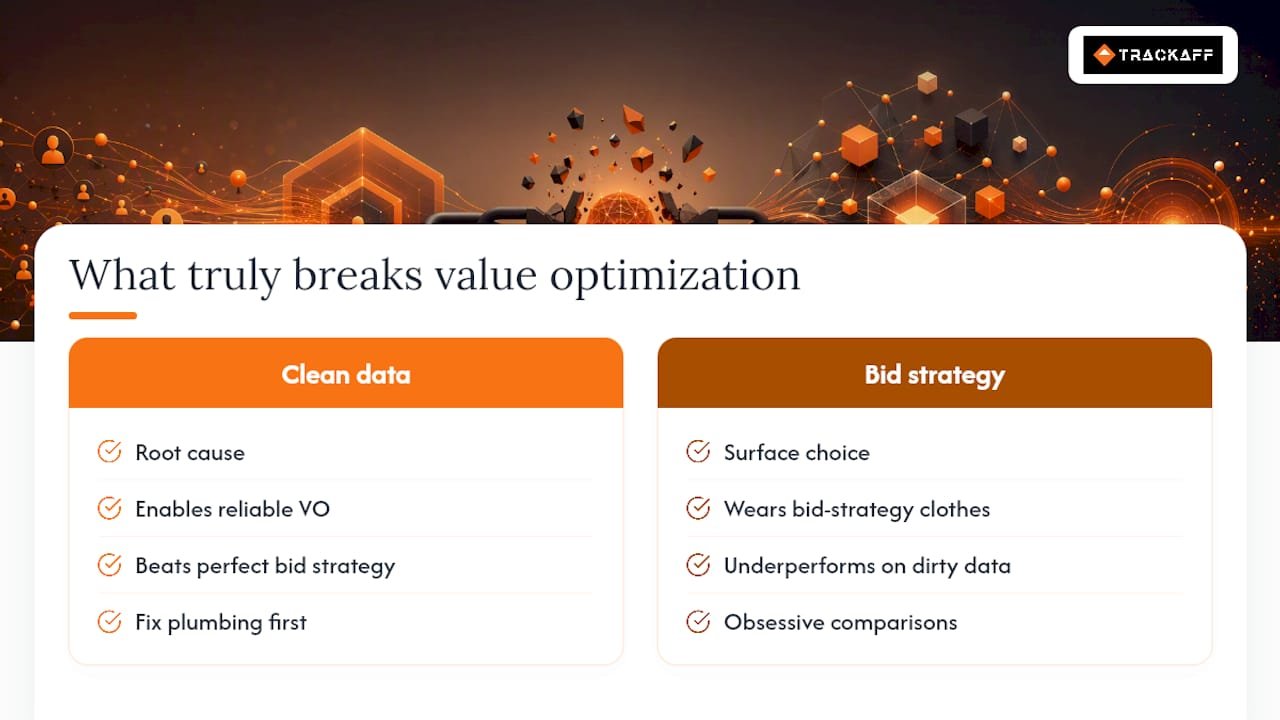
The industry’s obsession with bid strategy comparisons, Highest Value versus ROAS Goal versus Cost Cap, is a distraction from the harder, less glamorous work. A perfectly chosen bid strategy sitting on top of dirty value data will underperform a mediocre bid strategy sitting on top of clean data every time. That’s not a close call.
What gets overlooked most is the off-site conversion gap. Advertisers assume their Pixel and Conversions API setup is “done” once purchase events fire on a checkout page, then wonder why value optimization stalls when half their real conversions happen through a form, a phone call, or a CRM update days later. Fix the plumbing before you touch the bidding dial. Everything downstream depends on it.
— Terry
Get Accurate Post-Click Value Data With Trackaff
The single biggest lever in this entire guide, sending a clean, complete value signal, is exactly what breaks down when your real conversions happen off-site. Trackaff exists for that gap: a branded form captures the actual purchase, deposit, or registration after the click, then reports it to Meta through the Conversions API with deduplication built in.
That matters for value optimization specifically, because a value signal missing half your real conversions trains Meta on incomplete data, no matter how carefully you’ve configured your bid strategy. Trackaff’s CRM webhook integration means backend sales data flows into that signal automatically, without manual exports or spreadsheet patch jobs. If your funnel closes leads outside the browser, on a call, through a partner, inside a CRM, this is the layer that makes value optimization actually work as intended. Start a free trial at Trackaff and see what your current conversion signal is actually missing.
Sources
- About Maximizing the Value of Conversions
- Value-Based Bidding for Meta Ads in 2026: Send Profit, Not Revenue | Servo
- How to optimize Facebook ads (Shopify blog)
Recommended
Your deals close off the pixel. Meta never finds out.
TrackAff reports your real conversions back to Meta the moment they happen, tied to the exact ad that produced them. 10-minute setup, no code.
Start free 14-day trial → Card required · No charge until day 14 · Cancel in one click